The Majestic Feline: An Introduction
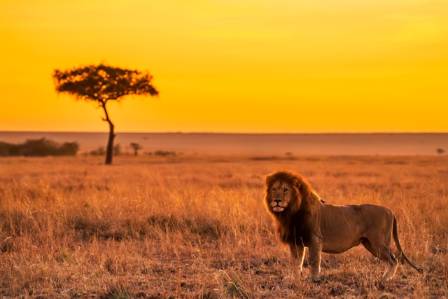
The lion (Panthera leo), a member of the feline family (Felidae), is a powerfully built creature, second in size only to the tiger. Renowned as an apex predator, it exists without natural enemies. This proverbial "king of beasts" has been one of the most iconic wild animals since ancient times. Primarily nocturnal, lions inhabit a range of environments but show a preference for grasslands, savannas, dense scrub, and open woodlands. While they once roamed much of Europe, Asia, and Africa, their current range is largely confined to parts of Africa south of the Sahara. A separate, slightly smaller population of approximately 500 to 700 Asiatic lions survives under strict protection in India's Gir National Park and Wildlife Sanctuary.
Physical Traits and Social Structure
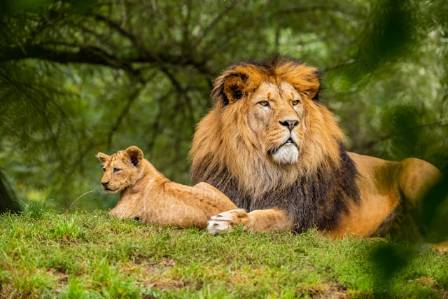
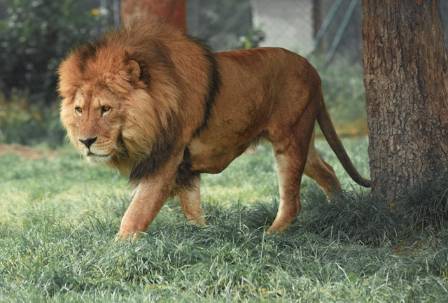
The lion is a robust feline, characterized by a lengthy torso, a large head, and relatively short legs. The physical differences between males and females are pronounced. The male's most distinctive feature is his mane, which differs among individuals and populations. It can be absent, form a light fringe around the face, or be full and shaggy, covering the head, neck, shoulders, and chest. In some lions, this mane is very dark, lending a majestic look. The mane amplifies the male's apparent size, potentially intimidating rivals or attracting mates. A mature male measures about 1.8–2.1 meters (6–7 feet) in body length, with a 1-meter tail, stands roughly 1.2 meters at the shoulder, and weighs 170–230 kg (370–500 pounds). The female, or lioness, is smaller, with a body length of 1.5 meters, a shoulder height of 0.9–1.1 meters, and a weight of 120–180 kg. Their coat is short, ranging in color from buff yellow and orange-brown to silvery gray or dark brown, and typically features a darker tuft on the tail tip.
Lions are exceptional among cats for their group-living social structure, known as a pride. Pride members often disperse into smaller groups during the day, reuniting to hunt or feed. A pride usually comprises several generations of related lionesses, a smaller number of breeding males, and their offspring. Group sizes can range from 4 to 37, with an average of about 15 individuals. Each pride maintains a defined territory, consisting of a core area defended against intruders and a peripheral area where some overlap is tolerated. Territory size fluctuates with prey density, from as small as 20 square km (8 square miles) to as large as 400 square km. Lions advertise their territory through roaring and scent marking, often roaring in the evening before hunting and at dawn. Males mark their presence by urinating on bushes, trees, or the ground, while defecation and rubbing against objects leave additional scent cues.
Hunting, Diet, and Feeding Habits
Lions have a diverse diet, preying on everything from rodents and baboons to Cape buffalo and hippos, though they primarily target medium-to-large hoofed animals like wildebeests, zebras, and antelopes. Prey choice can vary by region and between adjacent prides. While they are known to attack young or sick elephants and giraffes, lions are also opportunistic scavengers, readily stealing kills from hyenas, cheetahs, or wild dogs. In open savannas, lionesses are the primary hunters, while males often usurp the females' kills. However, males are capable hunters, especially in wooded areas or when they are nomadic and must fend for themselves.
Despite being a formidable predatory force, a significant number of lion hunts are unsuccessful. They often fail to account for wind direction, which can alert prey, and they tire quickly over short distances. Their typical strategy involves stalking from cover followed by a swift, short rush to tackle the prey, which is then subdued by a neck bite that leads to suffocation. The pride then converges on the kill, often fighting for access. Group hunts sometimes involve encircling a herd or creating panic to isolate a target. After a successful hunt, lions can gorge themselves, with an adult male consuming over 34 kg (75 pounds) in one meal before resting for several days. When food is plentiful, both sexes may spend 21 to 22 hours a day resting.
Reproduction and Life Cycle
Lions are polygamous and can breed year-round, though females typically mate with only one or two males in their pride. In the wild, breeding usually occurs no more than once every two years. When a female is in estrus, which lasts three to four days, a mating pair may copulate every 20–30 minutes. This frequent mating stimulates ovulation and helps ensure the male's paternity. The gestation period is approximately 108 days, resulting in a litter of one to six cubs, with two to four being most common.
Newborn cubs are vulnerable, blind, and covered in a spotted coat that fades as they mature. They begin to follow their mother at three months and are weaned by six or seven months. While they start joining kills at 11 months, they are unlikely to survive independently until they are two years old. Lionesses can be inattentive mothers, sometimes leaving their cubs alone for extended periods, leading to a high cub mortality rate (e.g., 86 percent in the Serengeti). Survival odds improve significantly after age two. Sexual maturity is reached at three or four years. Some females remain in their natal pride, while others are forced out. Male cubs are typically expelled from the pride around age three and live as nomads until they are strong enough (usually after age five) to challenge for leadership of another pride. Competition is fierce, and male coalitions of two to four individuals are more successful at holding a pride and siring offspring. When new males take over a pride, they often kill the existing cubs to bring the females back into estrus sooner. Females may try to defend their cubs, with greater success for older offspring. Lions in the wild rarely live beyond 8 to 10 years due to conflicts with humans, other lions, or injuries from prey, but they can live over 25 years in captivity.
Conservation Status and Challenges
During the Pleistocene Epoch, lions were widespread across North America, Africa, Europe, and Asia. Genetic evidence indicates the lion evolved in eastern and southern Africa, diversifying into several subspecies. While early 21st-century studies recognized up to 11 subspecies, more recent genetic evidence strongly supports just two primary subspecies: P. leo leo (found in India, West and Central Africa, and formerly North Africa and the Middle East) and P. leo melanochaita (found in Southern and East Africa).
Lions belong to the genus Panthera, which also includes leopards, jaguars, and tigers. In captivity, they have been hybridized with other big cats, producing ligers (lion father, tiger mother), tigons (tiger father, lioness mother), and leopons (leopard father, lioness mother).
Lion populations have drastically declined over millennia, vanishing from North America around 10,000 years ago and from parts of Europe and the Middle East more recently. Listed as vulnerable by the IUCN, their main stronghold is now sub-Saharan Africa, alongside the small, isolated Asiatic lion population in India's Gir Forest. A major conservation threat is conflict with humans, particularly livestock herders living near park boundaries. Diseases transmitted from domestic animals, such as the 1994 canine distemper outbreak in the Serengeti, also pose significant risks. Despite these challenges, lion populations remain stable in many protected areas and are a significant tourist attraction. However, high lion densities can negatively impact other endangered carnivores like cheetahs and African wild dogs, through competition and direct predation.