What Is a Serval?

Grove read

What Is a Serval?

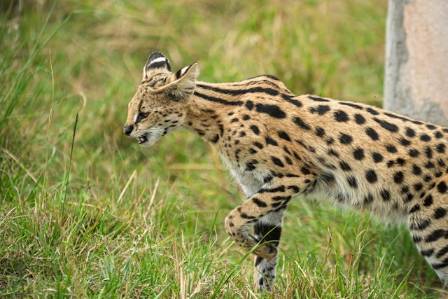
Servals are medium-sized African wild cats that may resemble stretched-out cheetahs because of their unusually long legs, slender bodies, and extended necks.

S

Silas

Margin note

Reading tip

The full digest continues below among botanical margin notes.

Grove

Olive Digests

What Is a Serval?

Servals are medium-sized African wild cats that may resemble stretched-out cheetahs because of their unusually long legs, slender bodies, and extended necks. These elegant predators move through the grasslands, wetlands, and wooded areas of central and southern Africa with remarkable grace.
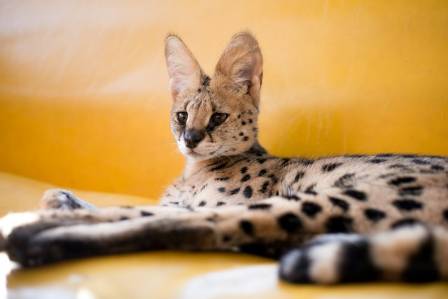
Each serval has a unique golden-yellow coat covered with dark spots and patterns. In some individuals, the spots are so tightly arranged that they appear almost like stripes. This special camouflage allows them to disappear among tall grasses and forest shadows, helping them avoid predators such as hyenas, African wild dogs, and leopards.

Exceptional Hunting Abilities

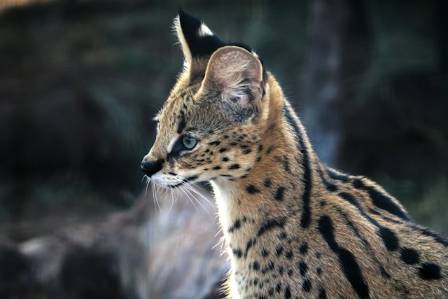
Servals are among the most specialized hunters in the cat family. Their extremely long legs and oversized ears give them advantages that few other cats possess.
Their height allows them to look over tall savanna grasses, while their powerful legs enable them to leap dramatically into the air. A serval can jump nearly nine feet (about 3 meters) high to capture birds in flight and can reach speeds of around 50 miles per hour over short distances.
Their large ears are not just for appearance—they provide excellent hearing ability. Servals can detect the faint movements and sounds of prey, including rodents moving beneath the ground.
These cats are ambush hunters, relying more on patience and precision than long pursuits. A serval may crouch quietly after locating prey by sound, then suddenly spring forward to catch small mammals, reptiles, or birds. Their curved claws also help them grab frogs and fish from water or pull rodents from underground tunnels.
Although they are relatively small compared with lions or leopards, servals have an impressive hunting success rate. They successfully capture prey in about half of their attempts, making them one of the most efficient hunters among wild cats.

Kittens and Savannah Cats

Servals are mostly solitary animals. Males and females usually live separately and mark their territories with urine and feces. They typically interact only during mating or when raising young.
There is no fixed breeding season for servals, although mating occurs more frequently during spring. Females become sexually mature at about 15 months, while males mature at around 17 months.
When a female is ready to mate, she communicates through increased scent marking and short vocal calls. During the brief mating period, which lasts around one to four days, the pair may stay together.
After a pregnancy of approximately 75 days, the female searches for a hidden and quiet location to give birth. A typical litter contains two or three kittens. Newborn kittens are blind and completely dependent on their mother, who raises them alone.
The kittens open their eyes after about one week and begin exploring outside the den at around three weeks old. They are usually weaned at approximately five months, when their adult teeth begin developing, and they gradually learn hunting skills by following their mother.
Because of their attractive appearance, servals have also influenced domestic cat breeding. The Savannah cat, created by crossing servals with domestic cats, has become a popular hybrid pet, although ownership is restricted or banned in some regions.

Conservation

Serval populations are currently considered stable. According to the International Union for Conservation of Nature (IUCN), servals are classified as Least Concern, meaning they are not currently threatened with extinction.
Despite this, servals still face several challenges. The greatest threat is the loss of wetland habitats, which provide important environments for rodents—their main food source. Urban expansion, agricultural development, and changes in land use reduce both their living areas and available prey.
Grassland burning can also harm servals by destroying populations of small animals they depend on for food.
Although servals sometimes hunt chickens, they rarely attack larger livestock. In fact, their ability to control rodent populations can benefit farmers. However, they are often misunderstood and treated as pests, leading to unnecessary persecution.
Servals are also hunted for their beautiful spotted coats, which may be sold as alternatives to leopard or cheetah skins. In some southern African cultures, serval skins have traditionally been used for ceremonial clothing, including by groups such as the Shembe Church in South Africa and the Lozi (Barotse) people of western Zambia.
To reduce pressure on wild cats, conservation organizations such as Panthera have developed artificial materials that closely resemble real animal skins. These alternatives have been adopted in traditional ceremonies and festivals. In 2019, the Lozi King supported this transition and banned the use of genuine wild cat skins in Lozi cultural ceremonies.

More along this branch

LF

LEAF · en

GTR VS Ferrari

GTR VS Ferrari

Addressing the intriguing question of whether an R35 Nissan GT-R can outpace a Ferrari leads to a nuanced exploration. Theoretically, with the appropriate modifications, a Nissan GT-R, much like a Honda Civic, can surpass a Ferrari in speed. However, the comparison becomes more nuanced when considering a stock Nissan GT-R against a Ferrari.

LF

LEAF · en

Sparkling Water: Why This Fizzy Drink Continues to Grow in Popularity

Sparkling Water: Why This Fizzy Drink Continues to Grow in Popularity

Sparkling water, often called carbonated water or seltzer, has become a popular choice for people who want a more exciting way to stay hydrated.

LF

LEAF · en

Perfect Cream Puffs in 4 Steps

Perfect Cream Puffs in 4 Steps

Cream puffs always look elegant—like something straight out of a Parisian pastry shop. But after making them countless times (and watching them disappear just as fast!), I’ve learned how to achieve that perfectly airy texture every time.

LF

LEAF · en

23 Coffee Table Decor Ideas: Elevate Your Living Space with Impactful Details

23 Coffee Table Decor Ideas: Elevate Your Living Space with Impactful Details

Small details hold immense power in interior design, and coffee table decor stands out as a transformative element that can redefine your living space’s ambiance. While arranging coffee table decor may seem daunting at first—what starts as a simple task can quickly feel chaotic with endless options—this versatile surface is actually your chance to showcase creativity, organization, and personal style. Best of all, coffee table decor is one of the most flexible aspects of your home: swap books for tabletop objects, puzzles for candles and flowers, or mix elements freely to create a decorative catchall that reflects your current obsessions. Below, discover curated ideas and principles to turn your coffee table into a focal point that feels intentional, stylish, and uniquely yours.

LF

LEAF · en

The Beauty of Crevice Gardens

The Beauty of Crevice Gardens

Who hasn’t been amazed by a dandelion pushing through a small sidewalk crack or a tree surviving on a rocky cliff? These examples remind us that plants can adapt to environments that seem impossible for growth. Many species have evolved to live in harsh conditions, and the combination of delicate foliage and flowers against rugged stone creates a unique visual effect. Crevice gardening gives gardeners the opportunity to recreate these natural scenes while experimenting with an unusual and artistic style of planting.

LF

LEAF · en

Raccoons: Clever Survivors of the Wild and Urban World

Raccoons: Clever Survivors of the Wild and Urban World

The raccoon (Procyon lotor) is classified among the carnivores, a mammalian group traditionally made up of animals that primarily consume meat. However, many members of this group are also capable of eating berries, fruits, vegetables, eggs, acorns, beech and hickory nuts, grains, grasses, and bark when other food sources are scarce. Carnivorous mammals have five toes and prominent canine teeth. Raccoons are omnivores, and the proportion of plant and animal foods they consume changes according to the season and what is available in their surroundings.