Grove read
Stripe Thought: The World’s 8 Most Amazing Zebras
Zebras are famous for their distinctive “barcode” coats, but look a little closer and you will discover that these remarkable African equids are far more diverse than their black-and-white appearance suggests.
Jasper Wells
Margin note
Reading tip
The full digest continues below among botanical margin notes.
Grove
Olive Digests
Zebras are famous for their distinctive “barcode” coats, but look a little closer and you will discover that these remarkable African equids are far more diverse than their black-and-white appearance suggests.
Grévy’s Zebra
Grévy’s Zebra (Equus grevyi) is the largest of the three zebra species and is also the biggest wild equid still living today. Sometimes called the Imperial Zebra, this impressive animal is native mainly to northern Kenya, with several small, isolated populations also surviving in central Ethiopia.
Grévy’s zebras have narrow, closely spaced black-and-white stripes that continue down toward their hooves. On the body, the stripes stop before reaching the completely white belly. Young foals are born with brown-and-white markings, with the brown portions gradually becoming darker and turning black as they mature.
Amazing Zebra Fact: Zebra milk consists of approximately 89% water, 7% lactose, 2.2% fat, and 1.6% protein. This highly diluted milk helps keep foals hydrated while enabling their mothers to conserve important nutrients.
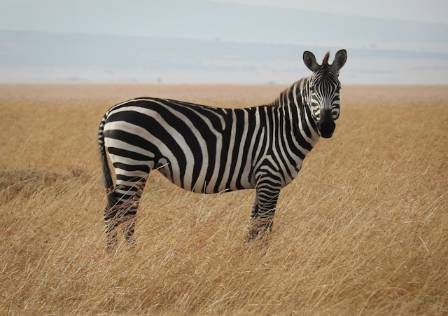
Grant’s Zebra
Grant’s Zebra (Equus quagga boehmi) is the smallest of the seven recognized subspecies of plains zebra. Fully grown individuals typically weigh between 485 and 700 pounds (220 to 315 kg), while adult Grévy’s zebras are considerably heavier, weighing approximately 770 to 990 pounds (350 to 450 kg). Grant’s zebras inhabit grasslands, savannas, and other open landscapes extending from southern Sudan and Ethiopia southward to central Angola and eastern South Africa.
Their markings consist of broad, clearly defined stripes. The stripes are mainly vertical toward the front of the body, become horizontal across the hind legs, and form diagonal patterns along the flanks. In the northern areas of their range, some Grant’s zebras have noticeably shorter manes, while others may have no mane at all.
Amazing Zebra Fact: Individual zebras can identify one another through their stripe patterns, which are different for every animal. Research has also found that zebras with a greater number of stripes may receive more social attention from their companions, including additional grooming.
Burchell’s Zebra
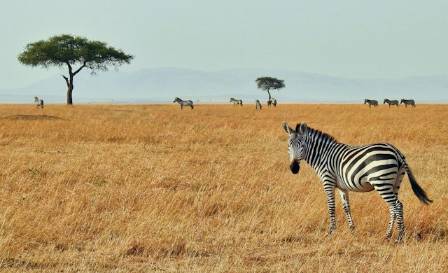
Burchell’s Zebra (Equus quagga burchellii) is a southern subspecies of the plains zebra. One of its most recognizable characteristics is the presence of brownish or pale buff “shadow stripes” positioned between the black stripes. These lighter markings generally extend from the middle of the torso toward the rump.
Burchell’s zebras live in stable family groups consisting of a single male stallion, a harem of one to six females, and their offspring. The females within these groups develop particularly strong social relationships. If the stallion dies, the females and young generally stay together until another male takes control of the group.
Burchell’s zebras are the only wild equids that are not currently classified as endangered. Nevertheless, their numbers have fallen in recent decades because of habitat destruction and illegal hunting.
Amazing Zebra Fact: Burchell’s zebra is the only zebra species or subspecies that can legally be raised for meat. The meat is especially valued by some athletes because it contains almost no fat, with only about 0.5 grams of fat per 100 grams. It also provides greater amounts of zinc and vitamin B12 and contains roughly 148 calories per steak, compared with approximately 230 calories in a beef rump steak of the same weight.
Chapman’s Zebra
Chapman’s Zebra (Equus quagga chapmani) is another subspecies of the plains zebra. These medium-sized zebras are found across the northeastern savannahs of South Africa, eastern Botswana, the Caprivi Strip in northern Namibia, and areas of southern Angola. Although Chapman’s zebras are not currently considered threatened, their population has decreased by approximately 25% in recent years as a result of human activities.
One of the most noticeable differences between Chapman’s zebras and other zebras is their coloration at birth. Their brown stripes do not necessarily become black as they grow older. Their stripes also tend to extend below the knees, where they become thinner and more numerous.
Amazing Zebra Fact: Although zebras may appear remarkably similar, the different types have significant genetic differences. Grévy’s zebras possess 46 chromosomes, plains zebras have 44 chromosomes, while mountain zebras have 32 chromosomes.
More along this branch
LEAF · en

What Is a Partial Solar Eclipse?
On August 21, a remarkable total solar eclipse will sweep across the United States, allowing observers in portions of 14 states to witness one of nature’s most spectacular astronomical events. While people located within the narrow path of totality will see the Moon completely cover the Sun, millions of others across North America will experience a partial solar eclipse. Although less dramatic than totality, a partial eclipse remains an impressive celestial display.
LEAF · en

Best Bike Stunts Ever
When it comes to two wheels, nothing captures the imagination like gravity-defying tricks. From daring flips to impossible spins, bike stunts have become a global spectacle that blends athletic skill with fearless creativity. Let’s take a ride through some of the most iconic moves, the legends who pulled them off, and how the sport continues to push forward.
LEAF · en
Incredible Facts About Beavers That Prove They Are The Ultimate Engineers of Nature
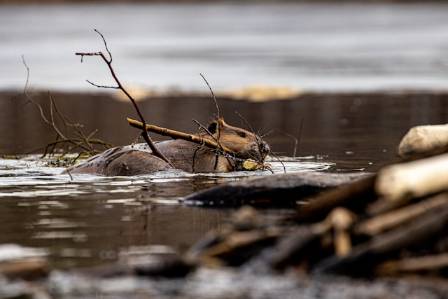
Beavers are truly remarkable creatures. They are the second largest rodents on the entire planet. Only the South American capybara is larger than them. These industrious animals play a massive role in our environment. They actively reshape entire ecosystems. They create vital new habitats for other wildlife. They even help our planet fight against the effects of climate change.
LEAF · en
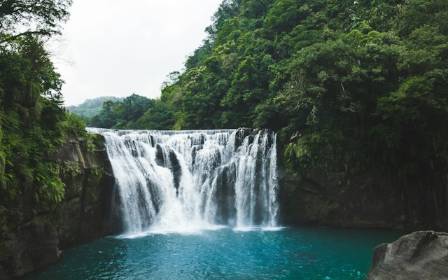
Where is Earth’s Largest Waterfall?
Rivers plunging through Earth’s deep gorges can produce spectacular waterfalls, natural wonders that attract millions of people with their dramatic beauty, immense scale, and tremendous force. Yet even the greatest waterfalls visible on land are dwarfed by enormous cascades hidden deep beneath the ocean.
LEAF · en
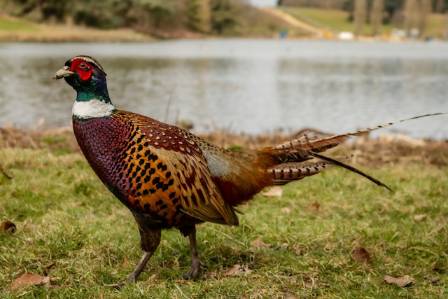
The Green Pheasant: A Rare Beauty at Risk
Green Pheasants, scientifically identified as Phasianus versicolor versicolor or P. v. robustipes, belong to the group known as True Pheasants. This group also includes the Ringneck Pheasant, Phasianus colchicus torquatus, commonly referred to as the Common Pheasant.
LEAF · en

Beijing's "Giant Egg" Named One of the World's Most Beautiful Concert Venues
Time Out has named Beijing's National Centre for the Performing Arts—known as "The Giant Egg"—one of the world's most beautiful concert venues, and the only Asian entry on the list. Opened in 2007 and designed by French architect Paul Andreu, the oval, glass-and-metal landmark is Asia's largest performance venue, housing an opera hall, music hall, and theatre. It hosts everything from original opera and weekly Chinese opera to international performances, including upcoming shows like Swan Lake, Carmen, and a Ryuichi Sakamoto tribute in 2026.