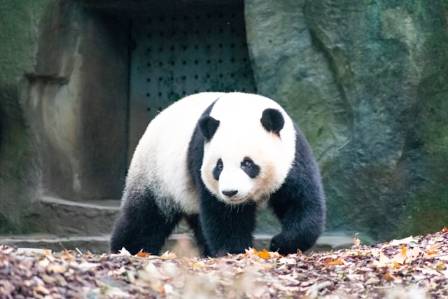
The giant panda (Ailuropoda melanoleuca) is one of the world’s most recognizable and beloved mammals, a member of the bear family distinguished by its striking black-and-white fur and gentle demeanor. Native exclusively to China’s mountainous regions, these iconic creatures have long captured global attention—not just for their adorable appearance, but also for their remarkable conservation journey, which has seen them rebound from the brink of extinction to a status of “Vulnerable” on the IUCN Red List. Beyond their cultural significance as China’s national treasure, giant pandas play a vital role in their forest ecosystems, serving as an umbrella species whose protection benefits countless other plants and animals sharing their habitat. From their specialized diet to their solitary lifestyle, every aspect of the giant panda reflects a unique adaptation to the challenging mountain environment they call home.
Taxonomy & Core Identity
Classified within the bear family Ursidae, the giant panda stands apart from its carnivorous relatives due to its highly specialized herbivorous diet, a trait that once led scientists to debate its evolutionary lineage—early researchers even placed it in the raccoon family before genetic studies confirmed its bear ancestry. Its scientific name Ailuropoda melanoleuca derives from Greek and Latin roots: Ailuros means “cat,” pous means “foot,” and melanoleuca translates to “black-and-white,” a nod to its distinctive coat pattern and the cat-like retractable claws that help it climb trees with ease. Unlike other bears, giant pandas lack a hibernation instinct; instead, they remain active year-round, moving to lower elevations in winter to find accessible bamboo when higher slopes are covered in snow. This unique combination of bear physiology and herbivorous behavior makes the giant panda a fascinating subject for evolutionary biologists, offering insights into how species adapt to drastic shifts in food availability over time.
Iconic Appearance & Adaptive Traits
The giant panda’s most famous feature is its bold black-and-white coat: black fur covers its eyes, ears, shoulders, legs, and chest, contrasting sharply with the white fur on its face, neck, back, and belly. For decades, scientists debated the purpose of this coloration, with theories ranging from camouflage to communication. Modern research suggests the pattern serves dual roles: the black patches on its eyes and ears help reduce glare in bright mountain sunlight and signal aggression to rivals, while the white fur blends with snow-covered terrain in winter, and the black shoulders and legs camouflage it among dark tree trunks and undergrowth in summer. Beyond its coat, the giant panda has several key physical adaptations: its enlarged wrist bone acts as a “sixth finger,” allowing it to grasp bamboo stalks with precision; its strong jaws and flat molars are designed to crush tough bamboo fibers; and its thick, woolly fur provides insulation against the cold temperatures of its mountain habitat, where winter lows can drop below freezing.
Habitat & Solitary Lifestyle
Giant pandas are endemic to the dense, mist-shrouded mountain forests of central China, primarily inhabiting the Qinling, Minshan, Qionglai, and Liangshan mountain ranges at elevations between 1,200 and 3,500 meters. These forests are dominated by bamboo stands, the panda’s primary food source, and feature a mix of coniferous and broadleaf trees that provide shelter and climbing opportunities. Pandas are solitary creatures by nature, with adults maintaining well-defined home ranges that they mark with scent glands located under their tails—scent marking helps avoid conflicts with other pandas, as encounters between adults are rare outside of the breeding season. Each panda’s home range varies in size depending on bamboo availability, with males typically occupying larger territories (up to 30 square kilometers) than females (10–15 square kilometers). Young pandas leave their mothers at around 18 months old, venturing out to establish their own ranges, and spend most of their lives alone, only seeking out mates during the brief breeding season between March and May each year.
Specialized Diet & Digestive Challenges
Despite being classified as a carnivore, the giant panda has evolved to survive on a diet that is 99% bamboo—a nutritional choice that presents unique challenges, as bamboo is low in calories and nutrients. To compensate, pandas spend 10–16 hours a day eating, consuming 12–38 kilograms of bamboo stalks, shoots, and leaves daily. Their digestive system, however, is still adapted for meat: unlike true herbivores such as cows, pandas lack a multi-chambered stomach and cannot fully digest cellulose, so they pass most of the bamboo they eat, extracting only a small portion of its nutrients. This inefficiency means pandas must eat constantly to meet their energy needs, and they prioritize the most nutrient-dense parts of the bamboo plant, such as young shoots in spring, which are easier to digest and richer in protein. On rare occasions, pandas will supplement their diet with small rodents, birds, eggs, or carrion, a reminder of their carnivorous evolutionary roots. This specialized diet also ties pandas closely to their habitat—any loss of bamboo forests directly threatens their survival, making habitat conservation a top priority for panda protection efforts.
Conservation Journey: From Endangered to Vulnerable

For much of the 20th century, giant pandas faced severe threats from habitat loss, poaching, and fragmentation, as China’s rapid industrialization and agricultural expansion destroyed large swathes of their bamboo forest home. By the 1980s, their wild population had dwindled to fewer than 1,200 individuals, and they were listed as “Endangered” on the IUCN Red List. In response, the Chinese government launched a series of aggressive conservation measures: establishing over 67 nature reserves dedicated to panda protection, implementing strict anti-poaching laws, and launching captive breeding programs to boost population numbers. International organizations also joined the effort, collaborating with Chinese researchers to study panda behavior, improve habitat connectivity, and develop techniques for reintroducing captive-bred pandas into the wild. These efforts paid off: in 2016, the IUCN downgraded the giant panda’s status from “Endangered” to “Vulnerable,” with wild populations now estimated at over 1,800 individuals. While this is a major conservation success, challenges remain—habitat fragmentation due to roads and human development still isolates panda populations, and climate change threatens to reduce bamboo habitats by up to 35% by the end of the century.
Cultural Significance & Ecological Value
Beyond their biological importance, giant pandas hold a special place in Chinese culture, where they have been revered for centuries as symbols of peace, harmony, and good fortune. Today, they serve as China’s official national animal and are global ambassadors for wildlife conservation, with “panda diplomacy” playing a role in international relations—China has loaned pandas to zoos around the world as a gesture of goodwill, fostering cross-border collaboration on conservation issues. Ecologically, giant pandas are considered an umbrella species: protecting their forest habitat benefits a wide range of other endangered species, including the golden snub-nosed monkey, takin, and red panda, as well as countless plant species that depend on the same mountain ecosystem. Pandas also play a role in forest regeneration: their foraging habits help thin bamboo stands, allowing new growth to flourish, and their feces spread bamboo seeds, contributing to the expansion of bamboo forests. In this way, the survival of the giant panda is intertwined with the health of China’s mountain ecosystems, making their protection a critical part of global biodiversity conservation.
Conclusion: A Symbol of Hope for Conservation

The giant panda’s journey from the brink of extinction to a recovering species is a powerful testament to what can be achieved through dedicated conservation efforts, government commitment, and international cooperation. As a beloved global icon, the panda has inspired millions of people to care about wildlife and habitat protection, proving that even the most endangered species can be saved with the right strategies and resources. Yet the work is far from over: to ensure the giant panda’s long-term survival, we must continue to protect its bamboo forest home, address the threats of climate change and habitat fragmentation, and support sustainable development that balances human needs with wildlife conservation. The giant panda is more than just a cute and cuddly animal—it is a symbol of hope, reminding us that with compassion and action, we can reverse the tide of biodiversity loss and preserve our planet’s most precious creatures for generations to come.