Grove read
The Evolution of Sushi: A Surprising Historical Journey
The global phenomenon of sushi—the combination of vinegared rice and fresh seafood—has a history that contradicts many modern assumptions. While today it is often viewed as a high-end Japanese delicacy, its roots trace back to ancient China, where it functioned as a preservation method rather than a fresh meal. Throughout the centuries, sushi has undergone radical transformations, evolving from a pungent, fermented street food into the diverse culinary art form enjoyed across the world today.
Tristan Mercer
Margin note
Reading tip
The full digest continues below among botanical margin notes.
Grove
Olive Digests
The global phenomenon of sushi—the combination of vinegared rice and fresh seafood—has a history that contradicts many modern assumptions. While today it is often viewed as a high-end Japanese delicacy, its roots trace back to ancient China, where it functioned as a preservation method rather than a fresh meal. Throughout the centuries, sushi has undergone radical transformations, evolving from a pungent, fermented street food into the diverse culinary art form enjoyed across the world today.
The Ancient Roots of Fermentation
Contrary to its modern image, the earliest form of sushi was not raw; it was fermented and notably sour. This primitive version, known as funazushi, can still be found near Lake Biwa in Japan. It involves aging fish in rice for a year or more, resulting in a flavor profile comparable to strong blue cheese. Historically, this process was a practical necessity. As cooked rice ferments, it produces lactic acid, which, when combined with salt, pickles and preserves the fish. This allowed seafood to remain safe for consumption for months or even years before the advent of refrigeration.
While this technique was practiced across East Asia for centuries, the transition toward modern sushi began in the bustling city of Edo—now known as Tokyo. As the urban population grew, so did the demand for quicker dining options. The long fermentation periods were gradually shortened, and cooks began adding vinegar and sugar directly to the rice to mimic the traditional tangy flavor without the wait.
The Rise of Nigiri and the "Fast Food" Revolution
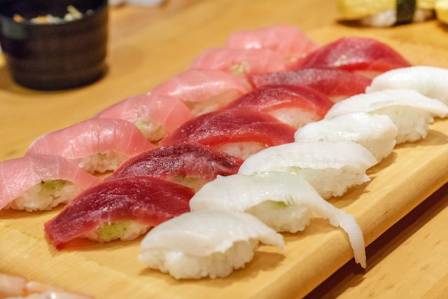
The definitive shift toward the sushi we recognize today occurred in the early 19th century. A peddler named Hanaya Yohei is often credited with revolutionizing the craft in 1810. Operating a stall in a high-traffic area of Edo, Yohei sought to speed up service for his customers. He began using fresh fish caught directly from Tokyo Bay, pairing it with rice seasoned with vinegar and salt that required only minutes to prepare.
This "fast food" innovation, known as Edomae or nigiri sushi, quickly became the urban standard. However, it took decades for this style to spread; as late as the 1940s, many in rural Japan were still unfamiliar with the raw fish preparation. The post-war economic boom and advancements in rice production—specifically the development of moist, chewy medium-grain rice in the 1960s—eventually solidified nigiri as a national staple.
From Nori Wraps to American Acceptance
The iconic seaweed wrapper, or nori, has its own distinct lineage. Rolled sushi, or norimaki, likely emerged around 1716, utilizing advanced papermaking techniques to create thin, edible sheets of seaweed. While Japan refined these methods, similar traditions of wrapping rice in seaweed existed in Korea, highlighting a shared regional history of using marine resources for portable meals.
Sushi’s journey to the West was a slow process that gained momentum several decades after World War II. In the late 1960s, critics in New York began noting a growing local enthusiasm for raw fish. By 1970, the opening of sushi bars near Hollywood studios attracted celebrities, turning the cuisine into a trendy luxury. The 1977 U.S. "Dietary Goals," which encouraged increased fish consumption for heart health and omega-3 benefits, provided the final push needed for sushi to move from elite coastal enclaves into mainstream American culture, eventually appearing in supermarkets and sports stadiums.
The Future of Sustainable Sushi
The history of sushi is defined by adaptation, and its future may be shaped by environmental necessity. Some historians and ecologists suggest that as traditional species like bluefin tuna face sustainability challenges, the industry may shift toward more abundant alternatives. For instance, Asian carp—an invasive species in North American waterways—has been proposed as a clean, sustainable, and flavorful option for modern sushi chefs.
Just as the practitioners of ancient fermented sushi could never have predicted the "raw revolution," the next stage of sushi's evolution will likely be driven by new culinary technologies and a commitment to ocean health. Sushi continues to be a living cuisine, constantly reinventing itself to suit the tastes and values of each new generation.
More along this branch
LEAF · en

The Most Iconic Sports Cars of All Time
Today’s sports car owners have countless reasons for choosing their dream rides. Some are obsessed with the deep rumble of a powerful engine when it revs, while others favor the agility and handling of sports cars over sedans and SUVs.
LEAF · en

The amazing Cuckoo
Most people can recognize the familiar sound of a Cuckoo calling, even if they have never actually seen the bird itself.
LEAF · en

12 Surprising Coffee Facts Every Enthusiast Should Know
For millions worldwide, coffee is more than just a beverage—it's an essential daily ritual. From morning espressos to afternoon cold brews, this aromatic drink fuels our days and warms our moments. While the average American enjoys three cups daily, did you know the world's most passionate coffee drinkers are actually found in Nordic countries like Finland and Sweden?
LEAF · en

Unmanned Aerial Vehicle
The Schmidt Ocean Institute provides support for drone or Unmanned Aerial Vehicle (UAV) operations by offering rental systems for approved research projects conducted aboard the R/V Falkor.
LEAF · en

10 Breathtaking Ocean Destinations Around the World
The ocean has long fascinated travelers with its sheer size, dazzling beauty, and air of mystery. From sun-soaked beaches to thriving coral gardens, it provides endless opportunities for exploration and relaxation. If you’re craving salty breezes and turquoise horizons, here are ten of the most captivating ocean destinations worth adding to your travel list.
LEAF · en

10 Iconic Manhattan Landmarks You Need to See
Manhattan, the bustling core of New York City, is packed with legendary buildings that showcase the city’s cultural, architectural, and historical significance. From soaring skyscrapers to renowned concert halls, these structures are as much symbols of the Big Apple as the Statue of Liberty. Here are ten of the most famous landmarks worth exploring.