Grove read
Mastering the Depths: A Comprehensive Guide to Underwater Art
Rendering underwater scenes requires a specialized approach to perspective and light. To create a convincing aquatic environment, an artist must often depict two worlds simultaneously: the atmospheric background above the surface and the submerged reality in the foreground. This transition creates a "window" effect that invites the viewer into the water.
Stephen Andrew Thornton
Margin note
Reading tip
The full digest continues below among botanical margin notes.
Grove
Olive Digests
Rendering underwater scenes requires a specialized approach to perspective and light. To create a convincing aquatic environment, an artist must often depict two worlds simultaneously: the atmospheric background above the surface and the submerged reality in the foreground. This transition creates a "window" effect that invites the viewer into the water.
Imagine observing a lake from a boat. When looking toward the horizon, your eyes catch the surface of the water, reflecting the sky or nearby foliage. However, as you look directly downward near the hull, that surface reflection vanishes, revealing the world beneath. The challenge for the painter lies in successfully balancing these two distinct visual states.
The Fundamental Principle of Water Painting
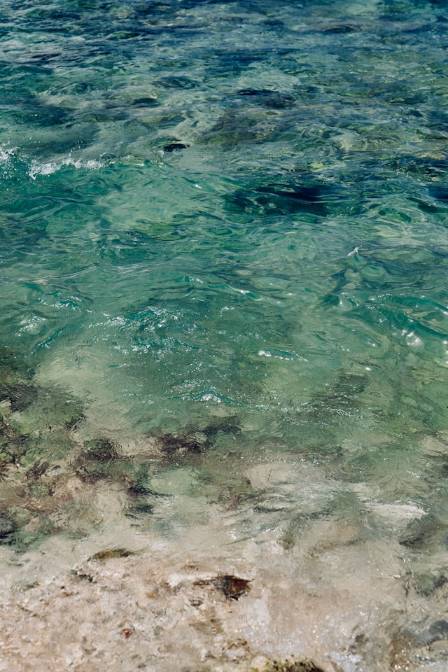
The most critical rule to remember when painting water is that horizontal surfaces primarily reflect what is above, while vertical views (or looking directly down) reveal what is beneath. The appearance of water changes based on the observer's viewing angle.
When you view water at an acute angle—anything less than 90 degrees—you see a reflection of the surroundings. This is why water often appears blue, as it mirrors the sky. However, as your viewing angle becomes steeper and approaches a perpendicular (90-degree) orientation, the reflection disappears. This creates a clear view through the surface to submerged fish, coral, or the lakebed.
Applying Atmospheric and Underwater Perspective
In traditional landscapes, atmospheric perspective dictates that distant objects become paler and bluer because particles in the air scatter light. In an underwater context, this principle shifts. While receding objects still become bluer, they actually grow darker rather than paler. This occurs because light originates from above the surface; the deeper an object sits or the further it recedes into the distance, the less light can reach it.
To create a believable sense of depth in an aquatic scene, you must adjust three elements as objects move away:
-
Hue: Shift the colors toward a deeper blue or teal.
-
Tone: Gradually darken the values to simulate light loss.
-
Contrast: Reduce the tonal range. Fewer details are visible in deep or murky water, so the difference between highlights and shadows should decrease.
Water clarity also dictates the intensity of these shifts. In a clear tropical reef, the changes may be subtle. In a sediment-heavy pond, objects might disappear into a dark green void within just a few feet.
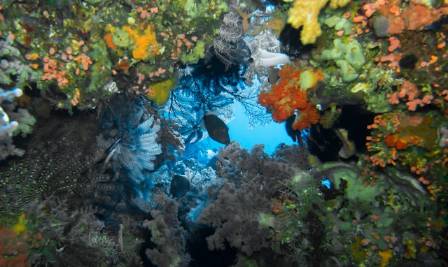
Examples of Underwater Perspectives
Different viewing angles require unique artistic strategies to maintain realism.
Surface-to-Depth Transitions
In scenes like a lily pond, the background should feature clear reflections of the sky and flowers. As the view moves toward the foreground, the angle becomes steeper, and the surface reflections should be faded out using a "glaze"—a thin, transparent layer of paint. This reveals the submerged stems and lakebed. Objects under the water are identified by their cooler, bluer tones and reduced contrast compared to those on the surface.
The Cross-Section View
This perspective acts like a glass-walled aquarium, showing the world both above and below the waterline. Above the water, colors remain warm (leaning toward reds and yellows). Below the surface, the palette shifts immediately to cooler blues. For a subject like a whale, the portion of the body extending into the depths should be significantly darker and bluer than the portion breaking the surface.
Viewing from Beneath
When the viewer is entirely submerged and looking upward, the underside of the water's surface acts as a mirror. Because it is being viewed at an angle from below, it reflects the world beneath the water (like the sea floor or a shark's belly) rather than the sky above. To make a creature appear to be swimming toward the viewer, its distant tail must be considerably darker and bluer than its head.
Core Techniques for Realistic Results
The secret to mastering this subject is to paint what you actually see rather than what you assume an object looks like. Human brains often simplify colors; we think of a whale as "gray" or a plant as "green," but underwater, those colors are radically transformed by light and depth.
By observing how light is filtered by the water and how the viewing angle dictates reflection, you can move beyond simple "blue water" and create a sophisticated, believable environment. Focus on maintaining high contrast and warmth in the foreground, while allowing the background to recede into a dark, low-contrast blue.
More along this branch
LEAF · en
Fascinating Facts About Lilies
With more than 100 known species, lilies are among the most diverse and visually impressive flowers in the world. Their wide range of colors, dramatic shapes, and captivating fragrance have made them one of the most beloved flowers across the globe.
LEAF · en

Eleven Reasons Arctic Foxes Are the Coolest
While researching Polar: Wildlife at the Ends of the Earth, I discovered countless fascinating animals, but arctic foxes have always been particularly special to me. Part of the reason is personal: I spent six years studying these foxes, along with wolves, during my PhD research. The other reason is much simpler—arctic foxes are truly remarkable animals. Here are some of the things that make them so impressive.
LEAF · en
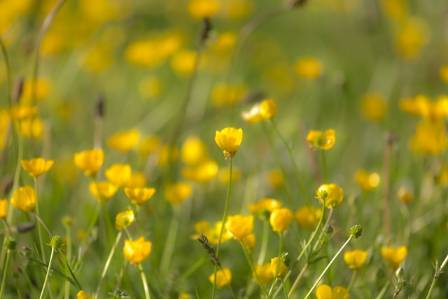
Buttercups as cut flowers
In June, the surrounding fields become covered in a soft golden glow. The vivid yellow buttercup blooms sway gently in the wind, their brilliant petals standing above the pink tones of flowering grasses. Their glossy flowers shine like polished lacquer, creating a beautiful natural display across the landscape.
LEAF · en
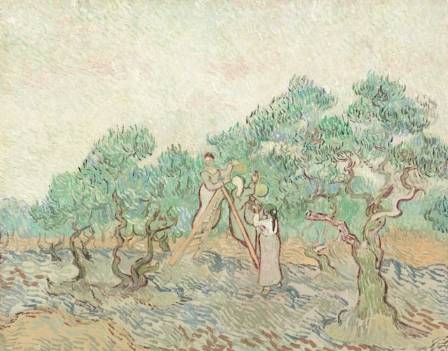
Autumn Harvest Art Intensive: A Five-Day Workshop in Drawing and Painting
Celebrate the arrival of the harvest season at the Coastal Maine Botanical Gardens with an immersive artistic journey. As the foliage transforms into brilliant hues and the air turns crisp, participants are invited to explore the abundant natural beauty of the Dahlia and Iris gardens. This comprehensive workshop spans five days, offering a deep dive into the techniques of capturing autumn’s bounty through illustration and painting. Designed for artists of all experience levels, including teenagers aged 14 and older, the course provides a serene environment to master the depiction of seasonal flora and harvests.
LEAF · en

3 Enigmatic Mouse Species
In the realm of rodents, a subtle distinction lingers between mice and rats, encapsulating a myriad of differences notwithstanding their shared rodent heritage. A pivotal identifier rests in their size, where rats loom larger and heavier compared to their diminutive mouse counterparts. Enshrined as distinct species, the enigmatic array of mouse varieties beckons for closer scrutiny and exploration. Let us embark on a journey unraveling the tapestry of mouse diversity across different habitats and regions.
LEAF · en

Alpine Skiing for Beginners
One of the great appeals of skiing is its flexibility—you can enjoy a relaxed scenic ride down gentle slopes or push yourself into a fast-paced, thrilling descent. Everything depends on the type of slope you choose. Among the many skiing styles, alpine skiing stands out as one of the most popular.