Grove read
Coleus: A Color for Every Garden
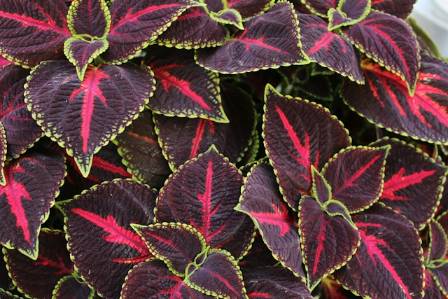
Coleus has been a dependable favorite in gardens for generations. It is primarily grown for its remarkable foliage, which comes in an enormous range of colors and patterns. These plants can tolerate a variety of soil conditions and can be grown in locations ranging from partial shade to sunny areas. Because of its importance and popularity as a garden plant, the National Public Garden Bureau designated 2015 as the Year of the Coleus.
Elowen Clarke
Margin note
Reading tip
The full digest continues below among botanical margin notes.
Grove
Olive Digests
Coleus has been a dependable favorite in gardens for generations. It is primarily grown for its remarkable foliage, which comes in an enormous range of colors and patterns. These plants can tolerate a variety of soil conditions and can be grown in locations ranging from partial shade to sunny areas. Because of its importance and popularity as a garden plant, the National Public Garden Bureau designated 2015 as the Year of the Coleus.
Coleus, scientifically known as Plectranthus scuttelarioides, has been cultivated for hundreds of years. However, its popularity increased dramatically during the past decade as a large number of new cultivars became available. Many of these newer selections were developed to tolerate considerably more sunlight than traditional coleus varieties.
Historically, coleus was primarily considered a shade plant. Many of the newer cultivars, however, perform particularly well with morning sunlight followed by afternoon shade. This is especially important in hot locations, such as areas next to south- or west-facing walls. Coleus can even tolerate full sun as long as the plants receive enough water and do not become stressed by drought.
Because coleus can develop into fairly large plants, maintaining adequate moisture during the hottest part of summer is especially important for keeping them vigorous and attractive.
Selecting the Right Coleus for Your Garden
Hundreds of coleus cultivars are available, so choosing the right variety begins with evaluating the location where you intend to plant it. First determine how much sunlight the site receives, then examine plant labels to find cultivars that are suited to comparable light conditions.
Although many newer varieties have improved tolerance for sunny locations, numerous cultivars still perform best in shade. Likewise, some varieties produce their strongest growth and most attractive colors when grown in brighter conditions but may become weak or lose their coloration when placed in excessive shade.
For instance, coleus with very pale or chartreuse-colored foliage can sometimes develop sunburn when exposed to too much direct sunlight. Varieties with darker foliage generally tend to tolerate sunnier growing conditions better.
Plant size can also differ substantially among cultivars. Always check the plant label for the expected mature dimensions. Some compact varieties may reach only about 8 to 12 inches in both height and width. Many of the newer introductions, however, can grow approximately 24 to 30 inches tall and 12 to 18 inches wide.
Growing Coleus
Coleus is remarkably simple to propagate. Stem cuttings readily produce roots when placed in a suitable propagation medium and kept consistently moist under high-humidity conditions until roots develop.
Until relatively recently, most coleus varieties sold at local garden centers were raised from seed. In recent years, however, an increasing number of vegetatively propagated cultivars have become available. These newer selections often provide exceptional diversity in foliage color, leaf dimensions, and leaf shape.
Vegetatively propagated coleus plants are frequently sold in larger containers, commonly four-inch pots or larger, while varieties grown from seed are more often sold in smaller cell packs.
Coleus is a warm-season plant that performs best during the heat of summer. Do not move these plants outdoors until the soil has warmed sufficiently and the danger of frost has completely passed. Plants placed in cold, saturated soil may become stunted and can require several weeks before they recover and resume vigorous growth.
Pinching the shoot tips before planting is also beneficial, particularly when a young plant consists of only one main stem. Using your thumb and finger, remove approximately the top half inch of the stem along with the upper couple of leaf nodes. This encourages the plant to produce additional branches, resulting in a fuller and more attractive appearance several weeks later.
Give coleus enough space to reach its mature size, but also consider how quickly you want the planting area to become visually full. Keep in mind that the “plant spread” listed on a label refers to the eventual mature size of the plant. If you want a planting bed to fill in more rapidly, the plants can be positioned closer together.
A single coleus can serve as an eye-catching focal or specimen plant, but these plants can also create especially dramatic displays when planted in groups. Arranging a dozen or more plants together can produce a bold mass planting with an impressive display of foliage.
Coleus also performs very well in containers. Choose a container that is sufficiently large for the selected cultivar, and make sure the plant will not eventually become so large that it overwhelms or hides other species growing alongside it.
Most coleus varieties have strong, upright growth, which makes them excellent focal-point or “thriller” plants in containers and even in hanging baskets. If a plant begins becoming excessively large, pinch or trim some of the stems. This encourages additional branching while helping maintain a manageable size.
Boundless Color and Cultivars
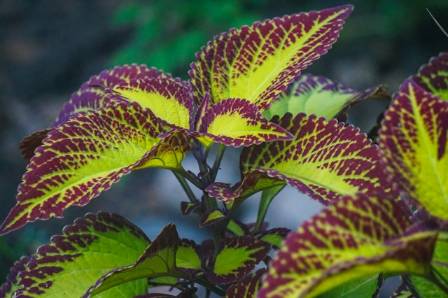
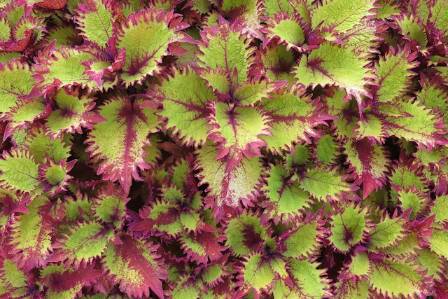
One of coleus's greatest attractions is the extraordinary range of foliage colors and patterns available. The variety is so extensive that finding a cultivar consisting of nothing but plain green foliage can actually be difficult.
Mosaic patterns are especially common. Different colors may appear around the edges of the leaves, along the major veins, or within the spaces between veins. Some cultivars display much smaller spots, flecks, or speckles across their leaves.
The undersides of the leaves, petioles, and stems can provide additional visual interest. Depending on the cultivar, these parts may either complement the foliage color or create a striking contrast with it. Leaf edges also vary considerably, ranging from smooth margins to toothed or deeply divided forms, adding even more possibilities when selecting plants.
Coleus belongs to the mint family and therefore displays several characteristics typical of that group, including square stems, opposite leaves, and upright flower spikes carrying tiny tubular flowers. These flowers are generally lavender or white.
However, flower spikes are often considered undesirable on ornamental coleus and are commonly pinched off as soon as they develop. Many breeders deliberately select plants that produce few or no flowers because gardeners generally prefer to emphasize the foliage rather than the blooms.
Trials conducted at McCrory Gardens have shown that most newer coleus cultivars produce very few flowers or none at all.
Over the years, numerous coleus cultivars have been evaluated at McCrory Gardens, including selections tested in both sunny and partially shaded locations. These trials have helped identify cultivars that perform particularly well under different garden light conditions.
More along this branch
LEAF · en

Curious and Remarkable Facts About Donkeys
Donkeys have played a vital role in human history for millennia, earning their place as reliable working companions. Despite being overshadowed by horses in popular culture, these animals are incredibly smart, tough, and socially complex.
LEAF · en

Exploring the Life of Toucans
Toucans, instantly recognized for their large, colorful beaks, are among the most iconic birds of the neotropical regions of the Americas. Beyond their striking appearance, they are important members of their ecosystems and boast an intriguing natural history. This guide explores the life of toucans, from their biology and behavior to their habitats and cultural significance.
LEAF · en

12 Warm Color Schemes Recommended by Interior Designers
These 12 Designer-Selected Warm Color Schemes Offer Unmatched Coziness When you want your living space to feel like the visual counterpart of curling up in bed on a cool autumn day with no plans that force you to leave the comfort of your covers, a warm color palette is exactly what you need. Shades of red, brown, cream, and more can help craft a welcoming atmosphere in any room, regardless of your personal style.
LEAF · en

Smart Buying Tips for Vacation Rentals
To maximize your investment returns, look for properties in prime destinations that offer high-demand features like pools, hot tubs, or scenic views. Prioritize locations with lower overhead to boost your capitalization rate.
LEAF · en

Qingdao Zhanqiao Pier, One Of The Most Famous Piers In China
As one of China's most celebrated piers, Zhanqiao Pier stands as both a historical monument and cultural symbol. Originally constructed during the German concession in 1891, this 440-meter-long pier has witnessed Qingdao's transformation from a colonial port to a modern metropolis.
LEAF · en

Draw Cartoon Animals
who doesn’t enjoy cartoons? there are countless beloved cartoon characters that bring joy to both kids and adults, with something to match every taste and age.