Grove read
The Art of Paper Folding: A Guide to Creating Handmade Origami Flowers
Origami is a timeless craft that transforms simple sheets of paper into intricate works of art. While it is a skill that can be practiced anywhere, its repetitive and focused nature makes it a particularly therapeutic hobby. Whether you are looking for a creative outlet during a period of rest or simply want to add a handmade touch to your home decor, folding paper flowers—specifically the popular kusudama style—is a rewarding project that is much easier to master than it initially appears.
Phyllis Joan Remington
Margin note
Reading tip
The full digest continues below among botanical margin notes.
Grove
Olive Digests
Origami is a timeless craft that transforms simple sheets of paper into intricate works of art. While it is a skill that can be practiced anywhere, its repetitive and focused nature makes it a particularly therapeutic hobby. Whether you are looking for a creative outlet during a period of rest or simply want to add a handmade touch to your home decor, folding paper flowers—specifically the popular kusudama style—is a rewarding project that is much easier to master than it initially appears.
Kusudama flowers are characterized by their five-petal structure and pointed, elegant appearance. While the process involves a series of specific steps, once you develop the muscle memory for the basic folds, you can produce dozens of petals quickly and efficiently. These individual blooms are beautiful on their own, but they can also be combined to create a striking geometric sphere known as a kusudama ball.
Supplies and Preparation for Folding
To begin, you only need a few basic materials. Traditional origami paper is ideal because it is thin and holds a crease well, but this craft is highly adaptable. You can use recycled materials such as magazine pages, old maps, newspaper, or even comic books. If you are cutting your own paper, a square size of 5 inches by 5 inches is recommended.
For assembly, a standard glue stick works well for individual petals. However, for the final assembly of the flower, a fast-drying tacky glue is often more effective. This type of adhesive "grabs" the paper instantly, preventing the petals from sliding out of alignment while the glue sets.
Creating Individual Petals
The foundation of the flower is the petal. Each bloom requires five identical petals to form a complete circle. The folding process begins with a square sheet of paper and involves a sequence of folds that create a small, triangular unit with decorative flaps inside.
Once the folding is complete, you apply adhesive to the outer flap and bring the two sides together, forming a cone-like shape. It is helpful to use your fingers to gently adjust the inner folds of the cone to ensure the center of the petal looks neat and symmetrical. A common strategy for efficiency is to fold all sixty petals needed for a full project first, then move on to the gluing phase in an assembly-line fashion.

Assembling the Completed Flower
When you have five finished petals, the next step is joining them together. A reliable method for achieving a balanced shape is to glue three petals into one group and the remaining two into another. Allow these smaller sections to dry completely before joining the two groups together to form the final five-petal flower.
Viewing the underside of the flower during this process can help you ensure that the points of the petals are meeting at a central axis. While the back of the work may not be as aesthetically pleasing as the front, its structural integrity is vital if you plan to connect these flowers into a larger arrangement.
Variations and Next Steps
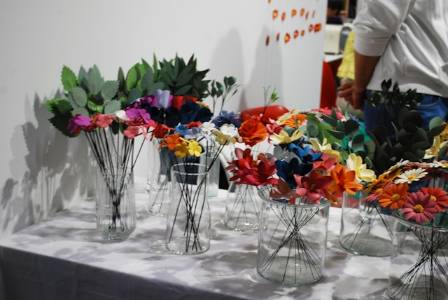
The versatility of origami allows for endless customization. Using "tie-dyed" or patterned papers can result in vibrant, multi-colored blooms that look stunning in a vase or as part of a centerpiece. For those interested in a more ambitious project, twelve of these finished flowers (totaling sixty petals) can be glued together to form a traditional kusudama ball, a classic piece of Japanese paper sculpture.
More along this branch
LEAF · en

The Most Diverse Primate Genus
High in the canopy of Central and South American rainforests, a remarkable genus of small primates demonstrates nature's incredible capacity for diversification within a single biological group. Squirrel monkeys, belonging to the genus Saimiri, comprise at least seven distinct species and seven subspecies, each adapted to specific regions and ecological niches throughout the Amazon basin and beyond. These agile, social creatures face varying conservation challenges across their range, offering a fascinating study in primate evolution and the pressing need for habitat protection.
LEAF · en

The Machinery Age: Innovation Driving the Modern World
Machinery has reshaped human civilization, redefining how we live, produce, and innovate. From the early stages of the industrial era to today’s cutting-edge automation, mechanical systems have continuously advanced our capabilities. This article revisits the journey of machinery through time, explores its social and economic impact, and looks ahead at how intelligent machines will influence the future.
LEAF · en

Largest Natural Arches in the World
A natural arch is a geological structure created when cliffs or rock formations are gradually worn away by erosion caused by ocean waves, rivers, wind, rain, or other natural forces. In some cases, water continues to flow beneath the opening, and the formation is referred to as a natural bridge. However, the difference between a natural arch and a natural bridge is not always clearly defined. The Natural Arch and Bridge Society considers a bridge to be a type of arch mainly shaped by flowing water, while geological references often describe a natural bridge as an arch that crosses an eroded valley.
LEAF · en

Top 10 At-Home Basketball Drills to Elevate Your Game: A Complete Guide for Players
Basketball excellence is forged not just in team practices or high-stakes games, but in the consistent, intentional work you put in on your own time. At-home training offers unparalleled flexibility to refine fundamentals, correct weaknesses, and build muscle memory—all without the need for a full court or teammates. Whether you’re a young athlete just starting out or a seasoned player looking to sharpen your skills, these 10 drills target every critical aspect of the game: ball handling, shooting, footwork, agility, finishing, rebounding, strength, and speed. By integrating them into your daily routine, you’ll develop the confidence and competence to stand out on the court. For members of Invictus Basketball Club, we’re excited to share that our exclusive Skills Lab homework will launch in video format this October—featuring step-by-step demonstrations and expert tips to amplify your at-home training. Read on to master these drills and take your game to the next level.
LEAF · en

Silk Secrets: Insider Tips for Styling Luxurious Silk
Master the elegance of silk with expert guidance. Discover how to combine textures, experiment with draping, and care for your silk pieces. Transform your outfits with fashion’s most cherished fabric.
LEAF · en

Annular Solar Eclipses: The “Ring of Fire” in the Sky
An annular solar eclipse is a rare and striking type of eclipse. It occurs when the Moon moves directly in front of the Sun but does not fully cover it. Instead, a bright outer ring of sunlight remains visible around the Moon’s silhouette. This glowing circle is known as an annulus, often described as a dramatic “ring of fire.”