Grove read
David by Michelangelo: A Renaissance Icon
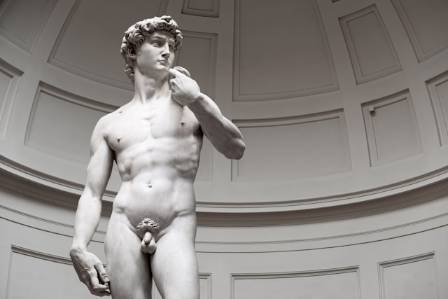
The biblical narrative of David, the youthful shepherd who conquered Goliath, captivated the imaginations of Renaissance sculptors. Yet, none reached the towering heights of fame attained by Michelangelo Buonarotti's rendition. This masterpiece stands as an exceptional work of art for a multitude of reasons.
Ella Skye
Margin note
Reading tip
The full digest continues below among botanical margin notes.
Grove
Olive Digests
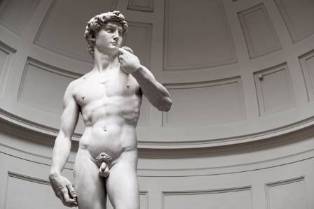
The biblical narrative of David, the youthful shepherd who conquered Goliath, captivated the imaginations of Renaissance sculptors. Yet, none reached the towering heights of fame attained by Michelangelo Buonarotti's rendition. This masterpiece stands as an exceptional work of art for a multitude of reasons.
Michelangelo, celebrated as one of the most extraordinary artists in history, was a polymath—an accomplished painter, sculptor, poet, and architect. He was an indefatigable workaholic, and his creative zeal persisted until he reached the ripe age of 89. Dubbed "the divine" by his peers, he bequeathed us enduring masterpieces, including the illustrious Sistine Chapel, the poignant Pietà, and, of course, the resplendent David.
In a deviation from his artistic contemporaries, Michelangelo portrayed David poised before the imminent battle. While Donatello and Andrea Verrocchio's renditions depict David triumphing over the severed head of Goliath, Michelangelo's interpretation captures the hero's untested resolve, embodying the moment of preparation before the forthcoming battle.
The Masterpiece Unveiled
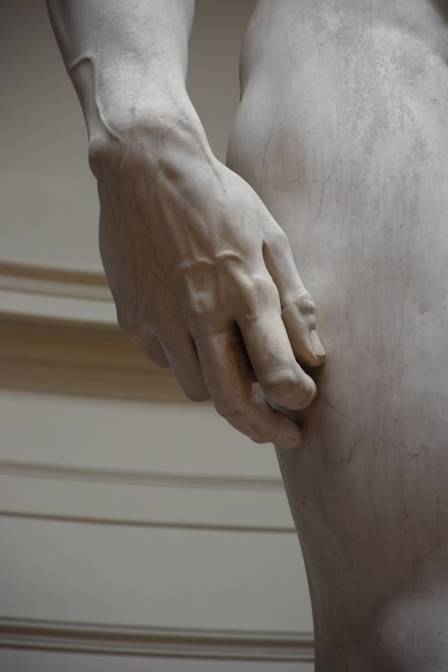
The story of David unfolds as that of a biblical hero who courageously vanquished Goliath, thereby rescuing the Israelites from the oppressive Philistines. Armed simply with a sling (draped over his left shoulder) and a concealed stone (grasped in his right hand), the unarmored young shepherd confronted the colossal adversary.
Michelangelo's sculpture presents David in a contrapposto stance, a pose characterized by an asymmetric distribution of weight to one leg. Here, his body leans on his right leg, with a tree stump serving as support. Completely nude, David wields only the sling and stone.
Despite his outwardly composed demeanor, the sculpture teems with the anticipation of impending battle, manifested in the meticulous details. David's visage and physique reverberate with the awareness of the task ahead. His head is turned at a three-quarter angle, brows furrowed, and nostrils flared, conveying an intense determination. His body exudes tension, evident in the tautly muscled neck, well-defined sinews, and meticulously carved veins. David's gaze is resolute, with pupils meticulously sculpted to enhance the intensity.
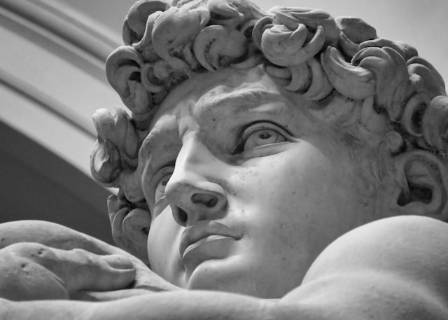
He stands prepared, his very posture evoking an imminent burst of activity. This representation defies the norm for a rigid, inert stone sculpture, as it exudes a surprising dynamism. The diagonals flowing from the shoulders, waist, and hips create an elegant S-shaped form, intensifying the perception of energetic potential.
A Symbol of the High Renaissance
The sling and the stone, though integral, are subtly incorporated into David's marble body, drawing only fleeting attention. Instead, the sculpture personifies not just the aesthetic of the High Renaissance, characterized by a rekindled reverence for ancient Greek and Roman culture, but also one of its core ideals.
Michelangelo's David is the epitome of rationality and intellect, focusing on the forthcoming challenge. It embodies the Renaissance ideal of a man whose victory isn't rooted in brute strength but in skill and reason. Although the sculpture portrays an idealized, robust male form, the emphasis transcends physical might to intellectual fortitude.
Michelangelo's Herculean Endeavor
The block of marble selected for Michelangelo's David was, in itself, a formidable challenge. At least three previous sculptors had attempted to carve it, each leaving the stone in a more dilapidated condition than before. The marble is at its most receptive when freshly quarried, before the hardening effects of age and exposure set in. With each successive endeavor, the block grew increasingly weathered, resistant, and slender.
Affectionately termed "the giant," the enormous stone had languished, abandoned for over four decades, as it was deemed flawed and too narrow for use. Much of the composition of Michelangelo's David was dictated by the constraints of the available marble. Every slender nuance and the arrangement of his limbs was a calculated decision to accommodate the narrow block that had previously been chiseled.
In September 1501, Michelangelo embarked on the monumental task of sculpting "the giant," completing his David nearly three years later. To access all dimensions of the colossal block, he erected a scaffold comprising at least three tiers. In a parallel to David defeating Goliath, Michelangelo triumphed over the formidable block of marble that had thwarted his predecessors. From a forsaken, flawed stone, he brought forth one of Italy's most celebrated artistic achievements, characterized by anatomical intricacies that continue to astonish.
When Michelangelo received the commission for this work, he was a mere 26 years old, and it marked a significant honor for such a young artist. At that juncture, he had yet to attain the enduring fame that now envelops his legacy. However, it was precisely his work on David that would transform his reputation, granting him "honor at home," as esteemed by his father.
Change of Plans
Originally commissioned to adorn the exterior of the Cathedral of Florence, situated more than 12 meters above ground, the colossal David was sculpted to be viewed from a distance. This fact explains both its substantial dimensions, standing at over five meters in height, and the perceptibly exaggerated proportions of his head and hands. When a replica was later mounted at this lofty vantage point, the proportions of the sculpture became more harmonious when observed from below. Nevertheless, the original David never assumed its designated position within the cathedral.
The reasons behind this relocation remain uncertain. It's plausible that the sculpture was deemed too extraordinary to be relegated to a lofty, distant perch, detached from public view. In 1504, Michelangelo's David found a new home on a platform in front of the Palazzo della Signoria, more famously known as Palazzo Vecchio, which served as Florence's seat of government. There, it stood until 1873 when it was transferred to its current abode within the Galleria dell'Accademia in Florence, safeguarded against further exposure-related deterioration. Since 1910, a replica has occupied the original location in front of the Palazzo Vecchio.
A Beacon of Florence's Identity
This sculpture not only commands artistic reverence as a remarkable feat by a young artist but also exudes profound social and political significance. It's intriguing to note the sculpture's transition from a religious to a secular context. Instead of residing within the confines of a cathedral, Michelangelo's David was stationed strategically to symbolically safeguard the city, evolving into a potent political emblem.
During this pivotal chapter in Florence's history, the city sought to reaffirm itself as a Republic. Having ousted the Medici regime in 1494 and witnessed the execution of Girolamo Savonarola in 1498, Florence was in a state of transformation. In this milieu, the biblical figure of David took on an extraordinary significance for the Florentine populace. They saw in him a paragon of exceptional strength and valor, a figure who had triumphed over adversity.
Beyond its aesthetic charm, signifying a distinct era of artistry, Michelangelo's David epitomized the spirit of the Florentine Republic. Its symbolic power was so compelling that, at one point, it endured the hurling of stones by Medici loyalists. Unscathed, it continues to resonate over 500 years later, a resounding symbol of its era.
More along this branch
LEAF · en

Blue Beauties: Meet The Eastern Bluebird
Bluebirds are among those birds that seem to inspire affection almost everywhere. They have appeared in songs such as “Bluebird” by Paul McCartney & Wings, in well-known poems like Emily Dickinson’s “The Bluebird,” and in expressions that have become part of our culture, including “The Bluebird of Happiness,” a phrase associated with Edward Heyman’s 1934 song.
LEAF · en

The Solar Dance of Sunflowers: Unveiling the Secrets of Heliotropism
Sunflowers, those captivating specimens of nature, unveil a dynamic aspect of plant life, challenging the notion of their static existence. Unlike the perception of plants as immobile entities, these particular flowers actively orient themselves toward the sun, tracing its journey from the eastern horizon to its western descent.
LEAF · en

7 Most Stunning Atolls Around the World
Atolls are nature’s tropical masterpieces—rings of coral that originally grew around islands and continued building upwards as the land sank or eroded. Found only in warm tropical and subtropical waters, these formations feature turquoise lagoons, colorful reefs, and vibrant marine life, offering dreamy beaches and the ultimate Robinson Crusoe experience.
LEAF · en

The 4 Seasons: Nature's Annual Cycle Explained
The four seasons — spring, summer, autumn (fall), and winter — are distinct periods of the year that encompass unique weather patterns and varying lengths of daylight. These cycles profoundly affect our environment, shaping the natural world and influencing human activities. Let's delve into each season's characteristics and the fascinating reasons behind their phenomena.
LEAF · en
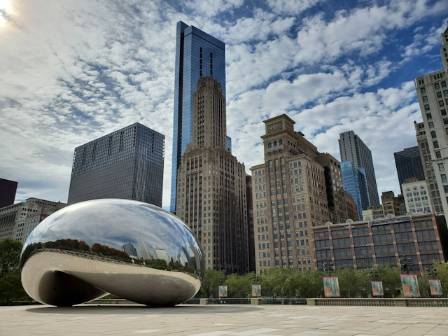
The Bean (Cloud Gate) in Chicago
Cloud Gate, commonly nicknamed “The Bean,” stands as one of Chicago’s most visited landmarks. This striking sculpture anchors Millennium Park in the city’s downtown area, reflecting Chicago’s iconic skyline and the surrounding green spaces.Here’s a full guide to The Bean — from its origins to how you can experience it today.
LEAF · en

The 10 Most Iconic Street Artworks Worldwide
Street art emerged in Philadelphia, USA, during the 1960s, fueled by the creative drive of artists like Cornbread and Cool Earl. Long dismissed as a lesser art form, it involves tagging walls, public transport, and buildings. Though illegal and transient—easy to cover up—street art has nonetheless captured the hearts of countless creators. Its goal is to make art accessible and visible to the masses, serving as a medium to convey deeper meanings and provoke thought. Today, some street art pieces command millions of dollars and are recognized as renowned works of art. Artsper presents the 10 most famous street artworks in the world!