Grove read
Masterpieces of the Natural World: 10 Iconic Landscape Paintings
Landscape painting was once a genre that struggled for the same prestige as historical or religious art. It wasn't until the 17th century that it gained formal recognition as a distinct category, standing alongside portraiture and still life. By the 19th century, particularly with the rise of the Barbizon School in 1830, the practice of painting outdoors—en plein air—became more accessible. Nature, with its lush forests and rugged coastlines, became a primary source of inspiration. The following selection highlights ten pivotal landscape works that have shaped the history of art.
Lucas Anderson
Margin note
Reading tip
The full digest continues below among botanical margin notes.
Grove
Olive Digests
Landscape painting was once a genre that struggled for the same prestige as historical or religious art. It wasn't until the 17th century that it gained formal recognition as a distinct category, standing alongside portraiture and still life. By the 19th century, particularly with the rise of the Barbizon School in 1830, the practice of painting outdoors—en plein air—became more accessible. Nature, with its lush forests and rugged coastlines, became a primary source of inspiration. The following selection highlights ten pivotal landscape works that have shaped the history of art.
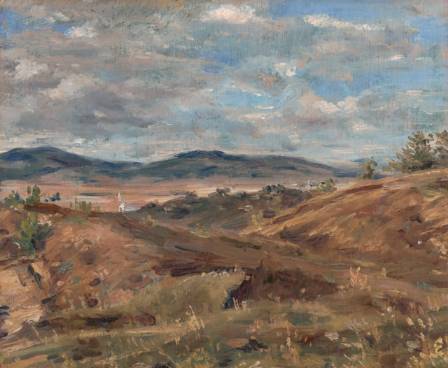
1. Nicolas Poussin: The Intellectual Landscape
The classical artist Nicolas Poussin was a pioneer of the "ideal landscape," a style where humanity and nature are harmoniously intertwined in a grand, majestic setting. His work invites viewers to contemplate the relationship between the divine and the mortal.
In his Four Seasons cycle, painted between 1660 and 1664 for the Duke of Richelieu, Poussin used biblical narratives as a framework for his environmental studies. In Spring, he depicts Adam and Eve in a verdant meadow. While the colors are warm and inviting, the presence of the Creator departing at the top right suggests the impending Fall and subsequent punishment. These works offer a dual perspective: a Christian linear view where God governs all events, and a cyclical view inherited from antiquity, where nature constantly regenerates.
2. Canaletto: The Urban Vista
Giovanni Antonio Canal, better known as Canaletto, specialized in the "Veduta," or highly accurate topographical views. These paintings were so precise that they often required technical aids like the camera obscura.
His 1727 masterpiece, The Grand Canal at the Church of La Salute, captures the late afternoon sun enveloping Venice in a soft, transparent glow. Beyond mere architectural accuracy, Canaletto populated his scenes with the daily bustle of the city, showing gondoliers, merchants, and foreign diplomats, turning a city view into a poetic documentation of 18th-century life.
3. Caspar David Friedrich: The Spiritual Horizon
Caspar David Friedrich was a leading figure of German Romanticism, an era that prioritized emotion and the sublime. His landscapes are often philosophical allegories that encourage deep introspection.
In Monk by the Sea (1808–1810), Friedrich strips the composition to its bare essentials. A lone figure stands before a vast, dark expanse of water and sky. The monk is a mere detail compared to the overwhelming scale of the environment. This work conveys a powerful message about human insignificance in the face of nature’s unpredictable and immense power, inviting the viewer's mind to wander into the unknown.
4. Eugène Boudin: The Essence of the Coast
Eugène Boudin, a native of Normandy, dedicated his career to capturing the interplay between the sea and the sky. He was a pioneer of open-air painting during a period dominated by rigid academic standards.
Boudin sought to record fleeting atmospheric conditions and the transience of light, earning him a reputation as a direct precursor to Impressionism. His 1865 work, Trouville Beach, showcases the burgeoning bourgeoisie of the time. However, his true subjects remained his "meteorological beauties"—the clouds and coastal light that he rendered with a rapid, suggestive technique that prioritized mood over minute description.
5. Vincent van Gogh: The Turbulent Night
Arguably the most famous landscape in history, Starry Night (1889) was created while Vincent van Gogh was seeking solace in Arles. The painting reflects his profound psychological state through its swirling patterns and high-contrast palette.
While the stars are based on real astronomical observations—the planet Venus was notably bright that year—the village itself is a product of Van Gogh's imagination. The dark, flame-like cypress tree provides a haunting counterpoint to the glowing celestial bodies. This central spiral may represent his internal turmoil or his deep admiration for the rhythmic structures found in Japanese woodblock prints.
6. Paul Cézanne: The Structural Obsession
Paul Cézanne was famously obsessed with the Sainte-Victoire mountain in Provence, depicting it in over eighty different works. He sought to move beyond the fleeting impressions of his contemporaries to find the permanent, underlying structure of the land.
In Sainte-Victoire seen from the Bibémus Quarry (1897), Cézanne used thick applications of paint and bold outlines to create distinct volumes. His tendency to simplify nature into geometric forms—treating the landscape as a series of cylinders, spheres, and cones—laid the groundwork for the Cubist movement. For Cézanne, the mountain was a living muse that breathed with the surrounding air.
7. André Derain: The Explosion of Color
L’Estaque, a small village in Southern France, became a focal point for the Fauvist movement. André Derain, working alongside artists like Matisse and Braque, used the intense Mediterranean light to redefine reality through color.
In his 1906 depiction of the village, Derain rejected naturalism entirely. He used a vibrant palette of reds, oranges, and blues to create a balanced, chromatic experience where color took precedence over traditional drawing. By emphasizing bold outlines and "wild" hues, he transformed a simple village scene into a radical modern statement.
8. Henri Rousseau: The Jungle Dream
At the end of the 19th century, Henri Rousseau emerged as a master of the Naive movement. His work is characterized by a lack of traditional perspective and a highly graphic, almost flat aesthetic.
His 1910 painting, The Dream, transports viewers to a dense, imaginary jungle filled with exotic animals. In the center, a nude woman reclines on a sofa, listening to a flute player. This surreal juxtaposition was interpreted by many, including Freud, as an allegory of subconscious desire. Rousseau, who never left France, drew his inspiration from the botanical gardens and museums of Paris, creating a lush, dreamlike world with over twenty shades of green.
9. Edward Hopper: The Quiet Coast
The landscapes of Edward Hopper are defined by a sense of mystery and profound isolation. He was particularly drawn to the architecture of New England and the Atlantic coast.
In Hill with Lighthouse (1927), Hopper presents a scene that feels strangely deserted despite being bathed in clear, sharp light. The lighthouse stands as a silent monument to loneliness. There is a tension between the man-made structure and the rolling hills, creating an atmosphere of stillness that borders on anxiety. By removing the presence of the sea, Hopper traps the viewer in a quiet, claustrophobic bubble of American solitude.
10. Nicolas de Staël: The Abstract Sensation
Nicolas de Staël approached the landscape through geometric abstraction and thick impasto. His work often explored the thin line between figuration and pure form.
Following a trip to Sicily in 1953, he created Sicily (View of Agrigento) in 1954. Although the landscape in August was actually dry and scorched, Staël used vibrant purples, reds, and yellows to convey the sensation of the heat and light rather than its literal appearance. The sharp horizon line creates a clear division between earth and sky, focusing on the essential energy of the place through strident color and bold, simple lines.
Whether through spiritual contemplation or abstract geometry, these ten artists demonstrate that landscape painting is less about recording a location and more about conveying the powerful emotions and impressions that the natural world evokes in the human spirit.
More along this branch
LEAF · en

Easy Homemade Fruit Jelly
Making your own fruit jelly at home is a rewarding experience. Bursting with natural colors and fruity flavors, this easy recipe lets you enjoy a sweet treat without relying on store-bought options. Whether you’re hosting a summer gathering, making a playful dessert for children, or looking for a quick fruity snack, this homemade fruit jelly is simple to prepare and always satisfying.
LEAF · en
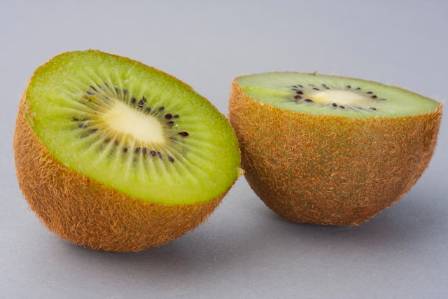
Is Kiwi Fruit Good for You During Pregnancy?
Kiwi, also known as Chinese gooseberry, is rich in essential nutrients and can be a great addition to your pregnancy diet. This small fruit offers a unique mix of vitamins, minerals, and fiber—plus a sweet, tangy flavor that may help satisfy pregnancy cravings in a healthy way.
LEAF · en
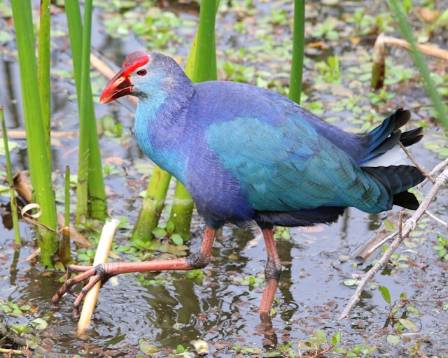
The Purple Swamphen
Last spring, during a three-month study abroad program in South Africa, I finally encountered one of my long-awaited lifer birds, the Purple Swamphen (Porphyrio porphyrio). I spotted it partially concealed among reeds in a large wetland within Wilderness National Park. After noticing me, the bird hurried across the water, attempting to disappear into the reeds on the opposite side of the shallow stream.
LEAF · en
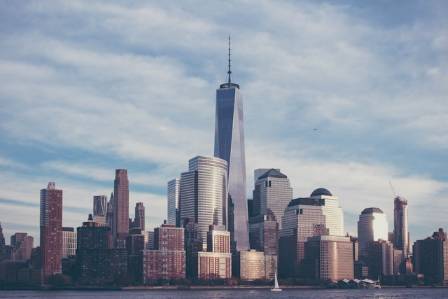
One World Trade Center: An Icon of Modern Architecture
One World Trade Center stands as a powerful symbol of resilience and innovation in the heart of New York City. Rising from the site of the original World Trade Center towers destroyed on September 11, 2001, this building not only serves as a functional office space but also represents the enduring spirit of progress and unity. It combines cutting-edge design with advanced safety features, redefining what a skyscraper can be in the 21st century.
LEAF · en
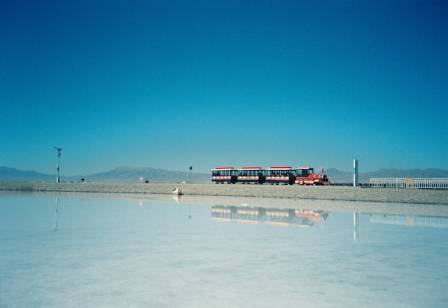
Chaka Salt Lake: Mirror Of The Sky
Chaka Salt Lake, located near the town of Chaka in Wulan County, is regarded as one of the most beautiful lakes in the Qaidam Basin of Northwest China’s Qinghai Province. In reality, Chaka is an enormous salt flat measuring roughly 9 kilometres from north to south and 15 kilometres across, with its surface covered by a thick layer of salt. During the dry part of the year, the visible lake becomes considerably smaller. After rainfall, however, the water spreads outward and the lake can reach its full extent.
LEAF · en
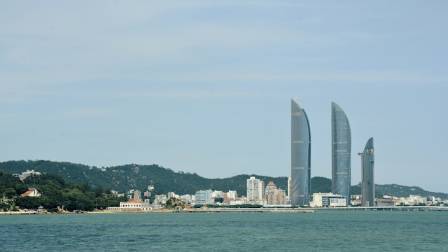
Xiamen Twin Towers
Located in the Yanwu area of Siming District, close to Xiamen University in Xiamen, Fujian Province, Xiamen Twin Towers is one of the city’s most important cultural and tourism landmarks. Recognized as a national 3A-level tourist attraction, the complex combines sightseeing, shopping, entertainment, leisure, and cultural experiences into one destination.