Grove read
What are Radio Telescopes?
Radio telescopes function in a way similar to optical telescopes, but instead of gathering visible light, they collect faint radio waves from space. These waves are focused, strengthened, and then analyzed using specialized instruments.
Emily Carter
Margin note
Reading tip
The full digest continues below among botanical margin notes.
Grove
Olive Digests
Radio telescopes function in a way similar to optical telescopes, but instead of gathering visible light, they collect faint radio waves from space. These waves are focused, strengthened, and then analyzed using specialized instruments.
Scientists use radio telescopes to study natural radio emissions from stars, galaxies, black holes, and other cosmic objects. They can also transmit radio signals toward planets and analyze the reflected waves. These instruments detect the longest wavelengths in the electromagnetic spectrum, ranging from about 1 millimeter to more than 10 meters. By comparison, visible light measures only a few hundred nanometers in wavelength—extremely tiny in scale. In practice, radio waves are usually described by their frequency rather than their wavelength.
By the time radio signals from space reach Earth, they are incredibly weak. In fact, the signal from a typical mobile phone is vastly stronger—on the order of a billion billion times more powerful—than the cosmic radio waves detected by telescopes.
Components of a Radio Telescope
Radio telescopes come in many designs depending on their purpose, but all include an antenna mounted on a structure and at least one receiver to capture incoming signals.
Because radio waves are so long and faint, radio telescopes must be very large and highly sensitive. However, this sensitivity also makes them vulnerable to interference from human-made electronics, so efforts are made to shield them from unwanted radio noise.
The Antenna
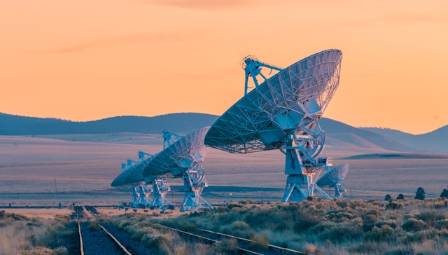
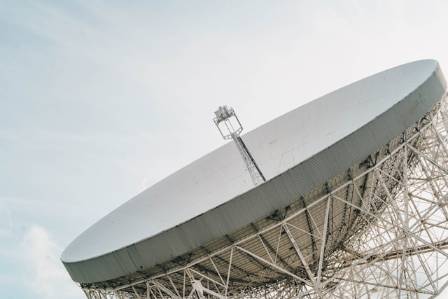
A simple antenna might be a metal dipole, like the kind used on car radios. However, the most effective design is the parabolic dish. This curved shape reflects incoming radio waves toward a single focal point above the dish.
Dish antennas can collect multiple wavelengths simultaneously, but different receivers are needed to isolate specific frequency ranges. To do this, scientists use devices called feed horns, which act like funnels to capture selected wavelengths. Some of these feed horns are extremely large—comparable in size to a pickup truck.
Each feed horn is designed so that its narrow end matches a particular wavelength. When the correct wave enters, it resonates efficiently within the horn, allowing a cooled receiver to detect the signal and send it to a computer for analysis.
Feed Support Systems
Feed horns and receivers can either be positioned directly above the dish at the focal point or connected through a secondary mirror that redirects the signal to a more accessible location.
If mounted above the dish, signals travel through cables down the support structure to ground-based equipment. However, this setup is limited by weight and maintenance challenges. More commonly, a secondary reflector directs the focused waves to receivers located near the center of the dish, making the system easier to manage and allowing multiple receivers to be used.
Dish Surface
For very short radio wavelengths, such as millimeter waves, the surface of the dish must be extremely precise. Even small imperfections can scatter signals and reduce data quality.
Environmental factors like wind, temperature changes, and gravity can distort large dishes. To maintain accuracy, some systems use smaller, precisely controlled dishes instead of a single large one.
For longer wavelengths, such as centimeter waves, the surface does not need to be as perfect. These dishes are built to be sturdy and can operate effectively under a wide range of conditions.
Mounting Systems
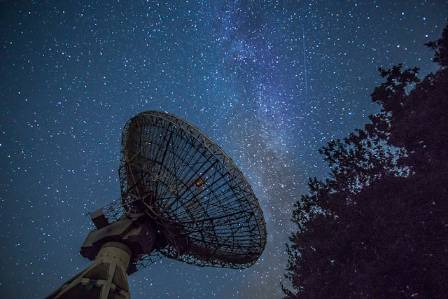
Some radio telescopes use equatorial mounts aligned with Earth’s rotational axis, allowing them to track objects in the sky by counteracting Earth’s rotation. However, building large telescopes with this design is complex due to the need for precise balance.
Most modern systems use computer-controlled mounts that move along simple axes, enabling large telescopes to be directed across the sky with high precision.
Signal Processing
Early radio telescopes could only observe one frequency at a time. Today’s systems can monitor thousands of frequencies simultaneously. Advanced computers divide incoming signals into many channels, providing much richer data—similar to moving from black-and-white imaging to full color.
To detect extremely faint signals, telescopes observe the same source for extended periods. By combining repeated measurements, the desired signal becomes clearer while random noise averages out.
Why Arrays Are Used
The ability of a telescope to resolve fine detail depends on the ratio between the wavelength and the size of the antenna. Because radio wavelengths are long, even very large single dishes have limited resolution.
To overcome this, multiple telescopes are combined into arrays, effectively acting as one विशाल instrument. The largest fully steerable dish, such as the 100-meter Green Bank Telescope, represents the practical limit for a single structure. Larger fixed dishes, like the one formerly in Arecibo, rely on moving receivers instead of the dish itself.
By linking multiple antennas spread across large distances, scientists can achieve much higher resolution. When two telescopes observe the same source, the signal reaches each at slightly different times. This difference creates a phase shift, which produces interference patterns when the signals are combined.
As Earth rotates and the telescopes track the source, these time differences change, providing multiple perspectives. The greater the distance between antennas, the sharper the resulting image.
In arrays like the VLA or ALMA, a central timing signal is distributed to each antenna via fiber optics. Each antenna mixes its data with this reference signal and sends it to a central computer called a correlator. This system synchronizes the data and combines it into a unified observation.
The correlator processes enormous amounts of data at extremely high speeds, performing trillions of calculations per second. Specialized software then converts this information into detailed maps of radio sources in space.
Very Long Baseline Interferometry (VLBI)
When antennas are separated by extremely large distances—even across continents—they form a system known as Very Long Baseline Interferometry. This technique allows for exceptionally precise measurements, including determining exact positions of distant objects.
Because connecting such distant antennas with cables is impractical, each site uses highly accurate atomic clocks to timestamp its data. These clocks provide timing precision down to billionths of a second.
The recorded data are stored and later transported to a central facility, where they are combined into a single dataset. This process allows scientists to achieve extremely high-resolution observations, even though the telescopes are separated by vast distances.
More along this branch
LEAF · en

Tracking volcanic rock to the shores of Belize
For many years, scientists have discovered pieces of pumice, a lightweight volcanic stone filled with tiny air pockets, scattered along the beaches and mangrove forests of Belize. The unusual discovery was puzzling because there are no active volcanoes located nearby that could have produced these rocks.
LEAF · en

15 Races in the US That Every Runner Needs To Do
For runners, the motivation to tie up our shoes is as varied as the races themselves. We chase personal goals, the thrill of competition, the weight of a finisher's medal, and the incredible community spirit. The real challenge isn't getting out the door, but choosing which iconic event to target. To help you decide, we've curated a list of the most legendary and breathtaking races across the United States.
LEAF · en

Largest Natural Arches in the World
A natural arch is a geological structure created when cliffs or rock formations are gradually worn away by erosion caused by ocean waves, rivers, wind, rain, or other natural forces. In some cases, water continues to flow beneath the opening, and the formation is referred to as a natural bridge. However, the difference between a natural arch and a natural bridge is not always clearly defined. The Natural Arch and Bridge Society considers a bridge to be a type of arch mainly shaped by flowing water, while geological references often describe a natural bridge as an arch that crosses an eroded valley.
LEAF · en

Guidelines for Selecting the Perfect Handbag Shade
Determining the ideal color for a handbag is a more nuanced task than it might initially appear. A well-chosen hue should complement your entire outfit while remaining appropriate for the current time of year. While modern fashion has moved away from rigid coordination rules, an mismatched choice can still disrupt the visual flow of an ensemble or appear out of place in certain settings.
LEAF · en

7 Delightfully Endearing Qualities That Men Appreciate in Women
If your friends often describe you as innocent, don't perceive it as an insult. You don't have to be a wild partygoer to capture a man's attention. In fact, many men find innocence incredibly appealing in a woman. Here are seven charmingly endearing traits that most men admire in women.
LEAF · en

10 Famous Animal Paintings by World-Renowned Artists
Animals have long been a central theme in art, symbolizing everything from strength and elegance to innocence and mystery. From ancient cave paintings to contemporary works, artists have been captivated by the beauty and meaning of the animal world. This article highlights ten of the most famous animal paintings by internationally acclaimed artists, each offering a distinct perspective on the connection between humans, animals, and nature.