Grove read
What causes ocean waves?
A visit to the seaside often brings images of sunshine, salty air, and waves rolling toward the shore. Surfers use them for riding, children splash through them, and swimmers dive beneath them. But these constantly moving patterns of water have a fascinating origin. So, what exactly creates waves?
Tristan Blackwell
Margin note
Reading tip
The full digest continues below among botanical margin notes.
Grove
Olive Digests
A visit to the seaside often brings images of sunshine, salty air, and waves rolling toward the shore. Surfers use them for riding, children splash through them, and swimmers dive beneath them. But these constantly moving patterns of water have a fascinating origin. So, what exactly creates waves?
The answer begins with wind, and ultimately, with energy from the sun.
How Sunlight Creates Wind
The sun does not heat Earth evenly. Areas near the equator receive stronger sunlight, while regions closer to the poles receive less warmth. This uneven heating creates differences in air temperature, which leads to the formation of wind.
Warm air rises because it is lighter, leaving space that is filled by cooler surrounding air. This movement of air from one area to another creates wind, which carries energy across the surface of the planet.
How Wind Transfers Energy to the Ocean
Wind acts as a moving source of energy. When it travels across the surface of the ocean, some of that energy is transferred into the water.
This energy causes the particles near the water’s surface to move. However, the water does not simply flow in the same direction as the wind. Instead, individual water particles move in circular patterns.
A surface water particle rises as a wave approaches. When it reaches the top of the wave, known as the crest, its movement slows. Gravity then pulls it downward into the lower section of the wave, called the trough, before it returns close to its original position.
The Circular Motion of Water
People standing in the ocean can feel this movement directly. As a wave rises beneath you, the water lifts your body upward. When the wave passes, you sink into the trough between waves and may also feel yourself moving slightly forward and backward.
If you were small enough to float freely with the water particles, your movement would follow a circular path. A floating buoy provides a good example of this motion, rising and falling repeatedly as waves pass beneath it.
How Ocean Swells Become Breaking Waves
When wind generates waves in deep water, the result is often large ocean swells. These swells are different from the waves people usually see along the beach because they appear more like smooth, rolling hills moving across the ocean surface.
The familiar shape of a breaking wave only develops when these swells enter shallow coastal areas.
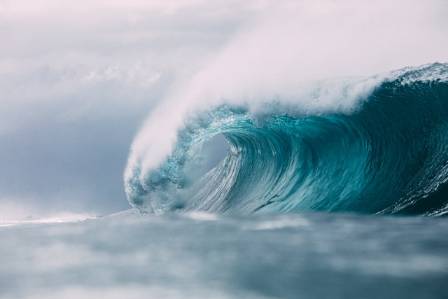
As the circular movement of water reaches the seabed, friction with the ocean floor slows the lower part of the wave. The water behind it continues moving forward, causing the wave to grow taller and steeper.
Eventually, the wave becomes too unstable to support itself. The top curls over, collapses, and crashes onto the shore before flowing back into the ocean.
Other Types of Powerful Waves
Not every wave that reaches land is created by wind. Some of the most destructive waves come from extreme natural events.
Large storms can produce storm surges, where rising seawater is pushed toward the coastline by powerful winds and low atmospheric pressure. These surges can flood coastal areas with enormous amounts of water.
Underwater earthquakes, volcanic activity, or landslides can generate tsunamis. Unlike ordinary waves, tsunamis can travel across entire oceans and arrive on shore as powerful walls of water capable of causing widespread destruction.
The Endless Motion of the Sea
From gentle ripples to towering waves, ocean movement is the result of energy traveling through water. The sun creates the conditions for wind, wind transfers energy to the ocean, and that energy shapes the waves that define our coastlines. Whether peaceful or powerful, waves are one of the most visible expressions of the planet’s natural forces.
More along this branch
LEAF · en

The Odd Looking Golden Snub-Nosed Monkey
The golden snub-nosed monkey, also known as the orange monkey, snub-nosed leaf monkey, or Sichuan golden-haired monkey, is found only in central and southwestern China and the mountainous regions of Tibet. These monkeys live at elevations ranging from about 5,200 to 13,000 feet.
LEAF · en

A Brief History of the SUV — and Why It Took the World by Storm
The Sports Utility Vehicle (SUV) isn’t just a car—it’s a cultural phenomenon. Walk through any suburban neighborhood, scroll through a highway traffic cam, or glance at annual sales reports, and one thing becomes clear: SUVs dominate. In the U.S. alone, over 12 million were sold last year, outpacing sedans, hatchbacks, and trucks. But this wasn’t always the case. The SUV’s rise from niche workhorse to global obsession is a story of war, innovation, and shifting human desires.
LEAF · en
Autumn Harvest Art Intensive: A Five-Day Workshop in Drawing and Painting
Celebrate the arrival of the harvest season at the Coastal Maine Botanical Gardens with an immersive artistic journey. As the foliage transforms into brilliant hues and the air turns crisp, participants are invited to explore the abundant natural beauty of the Dahlia and Iris gardens. This comprehensive workshop spans five days, offering a deep dive into the techniques of capturing autumn’s bounty through illustration and painting. Designed for artists of all experience levels, including teenagers aged 14 and older, the course provides a serene environment to master the depiction of seasonal flora and harvests.
LEAF · en

7 Fascinating Facts About the Equitable Life Building – The World’s First Skyscraper
New York City is celebrated for its skyline, but the modern era of tall buildings began with one bold experiment: the Equitable Life Building, finished in 1870. Often regarded as the first true skyscraper, it stood only eight stories tall, yet its innovations forever changed architecture.
LEAF · en
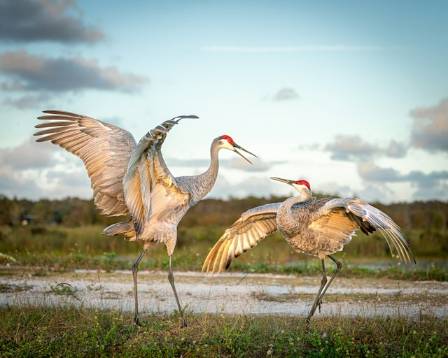
Sandhill Cranes and the “Orchestra of Evolution”
I will always remember the first time I heard a Sandhill Crane. It was early June, and I was about halfway through an eight-day backpacking journey in Montana's Sapphire Mountains. One evening, I was sitting in a meadow beside a quiet creek, filling my water bottle at an oxbow, when an extraordinary sound suddenly reached my ears. It sounded like a strange combination of an elephant, a jackhammer, and a squeaky old door hinge. Whatever was making it, I was convinced it could not possibly belong to any living creature I knew, and certainly not to a bird.
LEAF · en
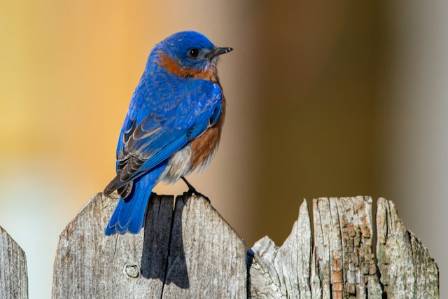
Blue Beauties: Meet The Eastern Bluebird
Bluebirds are among those birds that seem to inspire affection almost everywhere. They have appeared in songs such as “Bluebird” by Paul McCartney & Wings, in well-known poems like Emily Dickinson’s “The Bluebird,” and in expressions that have become part of our culture, including “The Bluebird of Happiness,” a phrase associated with Edward Heyman’s 1934 song.